
Have you asked how to study the Bible and still felt lost? Picture this: you’re at the controls of a complex aircraft, but someone handed you the wrong manual. You can flip switches and follow steps, yet the system won’t make sense—because the manual doesn’t match the machine.
That’s what happens when we use borrowed methods. The answer isn’t trying harder. It’s using the right blueprint.
Want a simple, step-by-step path? Begin with our Start Here guide.
How to Study the Bible When It Feels Like a Struggle
Recent statistics reveal a troubling reality: most Christians struggle with consistent Bible engagement. Among self-identified born-again Christians, approximately one-fifth to two-fifths don’t engage Scripture at all in a given week. As of 2021, only one in six U.S. adults read the Bible most days during the week, though 2025 data shows some improvement with weekly Bible reading climbing to 42% among all adults.

But here’s what’s even more revealing: research shows there’s a critical threshold called the “Power of 4.” Those who engage Scripture four or more days per week show dramatically different outcomes than those who engage less frequently. For behaviors like getting drunk and sex outside marriage, there’s negligible difference between Christians reading the Bible once a week versus not at all. The substantial differences only appear at four-plus days per week.
What does this tell us? Casual, scattered Bible study produces minimal spiritual impact. If you want a simple weekly plan for how to study the Bible four days or more, see our Start Here guide.
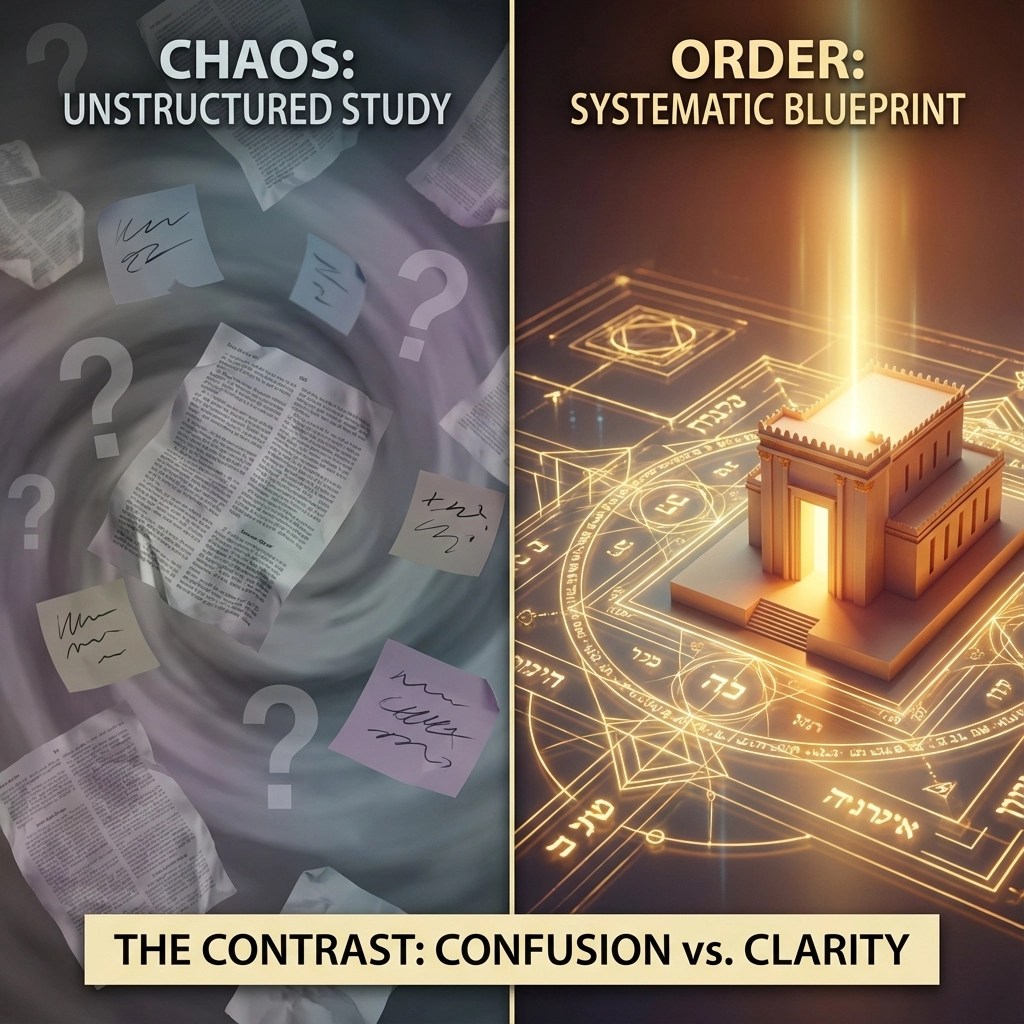
Think about your own Bible study experience. Have you ever felt like you’re collecting scattered biblical information but lacking systematic understanding? You read inspiring verses, recall moving stories, repeat familiar doctrines: but ask yourself to trace a biblical theme from Genesis through Revelation, and you struggle. Ask yourself to explain how Old Testament ceremonies relate to Christ’s current ministry, and you draw a blank.
This isn’t because you lack intelligence or spiritual devotion. It’s because you’ve been taught to approach Scripture like a collection of inspirational quotes rather than as a unified, progressive revelation with its own built-in interpretive framework.
How to Study the Bible With God’s Built-In Manual
Here’s what most Christians have never been told: God didn’t leave you to figure out Bible study methods on your own. He embedded His own interpretive framework right within Scripture itself. But here’s the tragedy: most believers have never been taught how to find it or use it.
The Bereans were commended specifically for their systematic approach: “These were more fair-minded than those in Thessalonica, in that they received the word with all readiness, and searched the Scriptures daily to find out whether these things were so” (Acts 17:11, NKJV). Notice what made them “fair-minded”: they didn’t just accept teaching emotionally. They methodically investigated whether it aligned with Scripture.
Jesus Himself appealed to careful scriptural investigation: “Search the Scriptures, for in them you think you have eternal life; and these are they which testify of Me” (John 5:39, NKJV). The word “search” implies methodical examination, not casual reading or mystical waiting for divine revelation apart from systematic investigation.
Paul commanded Timothy: “Be diligent to present yourself approved to God, a worker who does not need to be ashamed, rightly dividing the word of truth” (2 Timothy 2:15, NKJV). “Rightly dividing” requires intellectual precision, systematic methodology, careful analysis.
Can you see what this means? God expects you to engage Scripture intellectually! Not instead of spiritual dependence on the Holy Spirit, but as the very means through which the Spirit guides you into truth.

Figure: How to study the Bible through the sanctuary framework—Courtyard, Holy Place, Most Holy Place.
How to Study the Bible: Let Scripture Interpret Scripture
Here’s a principle that will revolutionize your Bible study: Scripture is designed to interpret itself when you use the right approach. This isn’t speculation: this is what the Bible explicitly teaches about its own nature.
Isaiah reveals God’s teaching methodology: “For precept must be upon precept, precept upon precept, line upon line, line upon line, here a little, there a little” (Isaiah 28:10, NKJV). Do you see the systematic nature of that approach? God builds understanding progressively, laying one truth upon another, connecting themes across different books and centuries of revelation.
This means that unclear passages should be understood in light of clearer passages addressing the same subject. Difficult verses should be interpreted by comparing them with straightforward verses on the same topic. Complex symbolic language should be decoded by finding where Scripture is the authority explains the symbols itself.
Peter confirms this principle: “Knowing this first, that no prophecy of Scripture is of any private interpretation, for prophecy never came by the will of man, but holy men of God spoke as they were moved by the Holy Spirit” (2 Peter 1:20-21, NKJV). Because Scripture has a unified divine source, it possesses internal consistency.
What does this mean practically? You have permission: indeed, you have responsibility: to investigate Scripture systematically, allowing clearer passages to illuminate more obscure ones, building comprehensive understanding precept upon precept. For a first-steps checklist on how to study the Bible this way, open our Start Here guide.
How to Study the Bible Using the Sanctuary Map
Here’s where everything comes together. Of all the biblical themes you could trace, one stands supreme as God’s own built-in interpretive framework for understanding all Scripture: the Hebrew Sanctuary.
Why is this so crucial? Because the sanctuary is the map that makes everything else in Scripture coherent. The sanctuary system wasn’t just about ancient Jewish worship: it was God’s visual curriculum, His architectural blueprint revealing the complete plan of redemption with Christ as the center.
The sanctuary reveals:
- God’s character in the courtyard layout and Holy Place furnishings
- The plan of salvation in the sacrificial system
- Christ’s two-phase ministry in the daily and yearly services
- The progression from justification through sanctification to glorification in the movement from courtyard through Holy Place to Most Holy Place
Consider this example: When you read about Christ being our High Priest in Hebrews, it can feel abstract without context. But when you understand the earthly sanctuary system: how the high priest ministered daily in the Holy Place and once yearly in the Most Holy Place: suddenly Hebrews makes perfect sense. Christ’s ministry has two phases, just like the earthly pattern. He’s not just “praying for us” in heaven; He’s conducting specific priestly work according to the sanctuary blueprint.
Without the sanctuary framework, you’re trying to assemble a puzzle without the picture on the box. With the sanctuary framework, every piece finds its proper place. Prophecies that seemed impossible to interpret suddenly make sense when understood through the sanctuary lens. New Testament passages that referenced “types and shadows” become clear.
From Scattered to Systematic: How to Study the Bible With a Blueprint
When you apply these systematic principles consistently, something remarkable happens. Bible study transforms from frustrating confusion to systematic discovery. Here’s what begins to change:
Prophecies make sense. Instead of competing interpretive systems that leave you confused, the sanctuary framework provides the timeline and context that makes prophetic passages coherent.
Old Testament relevance emerges. Instead of viewing Old Testament ceremonies as ancient history, you recognize them as God’s teaching tools revealing New Testament realities.
Confidence develops. Instead of feeling dependent on human authorities to tell you what passages mean, you develop skill in systematic investigation guided by the Holy Spirit.
Unity appears. Instead of scattered biblical knowledge, you see how everything connects: how Genesis relates to Revelation, how Daniel illuminates Hebrews, how the Psalms prepare for the Gospels.
The process is like switching from trying to navigate with random street signs to having a GPS with the complete map. The destination becomes clear, the route makes sense, and you can actually arrive where God intends. To put this into practice, follow the step-by-step plan in our Start Here guide.
Your Next Steps: How to Study the Bible with Confidence
You now understand what most Christians never discover: God provides both permission and methodology for systematic biblical investigation. You don’t need special spiritual experiences or seminary training. You need sound principles, careful thinking, and willingness to let Scripture guide your conclusions. For a clear first step on how to study the Bible, open our Start Here guide.
But here’s the critical question: What will you do with this knowledge?
Will you continue using fragmented study methods that leave you dependent on human authorities? Or will you embrace the systematic approach that Scripture itself demonstrates and commands?
The framework you’ve been seeking has been waiting in Scripture all along. The master key is ready to unlock treasures that will transform not just your biblical knowledge, but your entire relationship with Christ.
This is the way. The foundation is solid. The principles are biblical. The method is systematic. The results are transformative.
Ready to begin your journey as a systematic Truth Prospector?
🎯 Start Here: Complete Guide to Biblical Study Methods →
📖 Get “This is the Way” – Your Systematic Study Blueprint →
🤝 Join Fellow Truth Prospectors in Our Community →
“For precept must be upon precept, precept upon precept, line upon line, line upon line, here a little, there a little.” : Isaiah 28:10 (NKJV)
The sanctuary framework awaits your discovery. The systematic method stands ready for your application. The transformation God intends is just beginning.
Will you answer the call?
Leave a Reply